Classic “General’s Salad” (Layered Beet, Carrot, Chicken, Egg, and Cheese Salad)
There are a few ways people build this salad, depending on the family and the occasion. Today we’re going with the classic version-the one that looks like a clean parade of color when you slice into it, and tastes even better after it’s had a little time to chill and “pull itself together.”
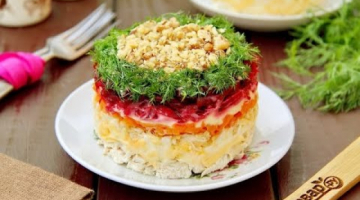
This is a layered salad built from simple, familiar ingredients: tender cooked chicken (or other meat), hard-boiled eggs, cooked beets and carrots, a salty firm cheese, and a thin spread of mayonnaise between layers. On top: a light, decorative finish-walnuts and fresh dill if you want the traditional “dress uniform” look.
It’s not a complicated dish, but it rewards discipline. The difference between “nice home salad” and “wow, that looks restaurant-level” is mostly about texture control, layer order, and resting time.
Quick Snapshot
Servings: 4
Total time: about 1 hour 20 minutes (mostly cooking + cooling)
Active time: about 20 minutes
Best served: slightly chilled, not icy cold
Ingredients (Classic Version)
Below you’ll see US-friendly amounts with the original metric as a reference.
-
Cooked chicken (about 7 oz / 200 g)
I use chicken breast, but you can swap it-see variations below. -
Firm cheese (about 3 oz / 80 g), grated
Choose something with a salty bite and a clean melt profile: aged Gouda, Swiss, or a wedge of Parmesan for a sharper finish. -
Carrot – 1 medium, cooked, grated
-
Beet – 1 medium, cooked, grated
-
Eggs – 2 large, hard-boiled, grated
-
Mayonnaise – to taste (usually 6–8 tablespoons total for a standard build)
-
Salt – to taste
-
Walnuts – to taste, for topping
-
Fresh dill – to taste, for topping
Optional but helpful
-
White pepper (a pinch) for the cheese layer
-
Smoked paprika (a tiny pinch) for the chicken layer
-
Dijon mustard (if you’re making a lighter dressing alternative)
Why It’s Called “General’s Salad”
Layered salads have been a staple across Eastern European home cooking for decades-especially on holiday tables, birthdays, and big gatherings where food is expected to look festive, not just taste good.
This one earned a “ranked” name because it behaves like a uniform: bright stripes, polished surface, strict order. Even if you’ve never seen it before, the moment it arrives on the table it signals: this is not a casual Tuesday snack. It’s a salad that shows up when guests are coming, when the plates are nicer, when someone says, “Let’s do it properly.”
And yet the ingredients are ordinary-almost stubbornly so. That’s part of the charm. The drama comes from structure and contrast:
-
sweet earthiness of beets,
-
gentle sweetness of carrots,
-
savory protein from chicken and egg,
-
salty, nutty edge from cheese,
-
creamy “glue” holding everything in formation.
What This Salad Tastes Like (So You Know What You’re Building)
This isn’t a crunchy salad. It’s a soft, cohesive, sliceable salad-more like a composed terrine than a tossed bowl.
You get:
-
a tender base (chicken),
-
a mellow creamy center (egg + mayo),
-
a warm sweetness from cooked vegetables,
-
a salty finish from cheese,
-
and-if you add walnuts-a toasted bite that keeps it from feeling too smooth.
It’s especially good when it has rested, because the flavors stop standing separately and start moving like a single unit.
Ingredient Strategy: Picking the “Right Soldiers”
Small choices matter here. Because the ingredient list is short, every shortcut shows.
Chicken (or other meat)
For the classic build, cooked chicken breast is reliable: mild flavor, easy texture, clean slices.
How to choose it (if buying raw):
-
look for firm, pale pink meat,
-
avoid excess watery liquid in the package (that can mean it will cook up stringy),
-
don’t overcook it-dry chicken is the fastest way to make this salad feel “chalky.”
Good swaps:
-
cooked turkey breast (very similar),
-
slow-cooked beef (richer, more “banquet”),
-
smoked turkey (adds instant depth),
-
duck breast (bold, dramatic, not subtle).
Beets
Beets are the final “uniform coat.” They determine the look and a big part of the sweetness.
Best practice: cook them with the skin on, without trimming the tail.
That helps keep color and flavor inside the beet instead of leaking into the water.
Texture target: tender and velvety, not watery. A beet that’s too watery can make the entire salad weep.
Carrots
Carrots bring warmth and light sweetness.
Try to avoid carrots that have been sitting around too long and taste woody. The sweeter and juicier the carrot, the more alive the salad feels-even though the carrot is cooked.
Eggs
Hard-boiled eggs should taste clean, not sulfurous.
Simple rule: don’t overboil. Overboiled eggs get that gray-green ring around the yolk and a stronger smell. Not fatal, but noticeable in a dish this gentle.
Cheese
The cheese layer is where you can nudge the salad toward “everyday” or “special.”
-
Aged Gouda / Swiss: smooth, classic, balanced.
-
Parmesan: sharper, saltier, more “grown-up.”
-
Cheddar: works, but can dominate if very sharp.
Avoid very soft cheeses here. You want a cheese that grates cleanly and holds its place.
Walnuts
Walnuts are optional, but they add the kind of depth people can’t always name-just that “mmm, what is that?” moment.
If you toast them lightly, they become warmer, more fragrant, and less bitter.
Mayonnaise
Use what you like, but keep one principle: thin layers.
Too much mayo turns the salad heavy and dull, and the beautiful stripes blur into a single beige idea.
If you want a lighter version, you can use a yogurt-based dressing (I’ll give a good one below), but classic mayo gives the most faithful taste and texture.
Equipment (Nothing Fancy, But One Thing Helps)
-
Cutting board + knife
-
Box grater
-
Mixing bowls (separate bowls matter here)
-
Spoon or offset spatula for smoothing layers
For the cleanest shape
-
A food ring (about 6 inches / 16 cm diameter)
No ring?
You can make a DIY one by cutting the top and bottom off a clean plastic bottle to create a cylinder. It’s not glamorous, but it works-and it’s exactly the kind of kitchen improvisation that keeps recipes alive.
Step-by-Step: “General’s Discipline” in the Kitchen
1) Cook and cool everything first
This salad is easier when you stop fighting heat.
Cook the chicken
If you’re starting from raw chicken breast:
-
Place chicken in a pot and cover with water.
-
Add salt, a bay leaf, and a few peppercorns if you want.
-
Bring to a gentle simmer (not a rolling boil).
-
Cook until done-usually 12–18 minutes depending on thickness.
-
Cool it under a loose cover so it doesn’t dry out.
Texture tip: gentle simmer = tender chicken. Hard boiling = stringy chicken.
Cook beets and carrots
You can boil or roast them. Both work.
Boiling method (classic):
-
Boil beets and carrots (separately if you want perfect color control) until tender.
-
Cool completely.
-
Peel after cooking (skins slip off more easily).
Roasting method (more concentrated flavor):
-
Wrap beets in foil and roast at 400°F until tender (often 45–70 minutes depending on size).
-
Roast carrots unwrapped or in foil until tender.
-
Cool, then peel/grate.
Roasted beets taste deeper and less watery. If you’re trying to impress, roasting is the quiet cheat code.
Hard-boil eggs
-
Place eggs in a pot and cover with cold water.
-
Bring to a boil.
-
Reduce to a steady simmer and cook 10 minutes.
-
Transfer to an ice bath or very cold water.
-
Peel once cool.
2) Prep: chop and grate with intention
This is where a lot of salads go wrong-when everything gets tossed into one bowl and becomes a colorful mush before it even reaches the plate.
Chicken
Dice into neat cubes-about ⅓ inch (8 mm).
Uniform pieces help the salad slice cleanly and feel evenly balanced.
Vegetables and eggs
Grate beets, carrots, and eggs on the large holes of a box grater.
Keep each ingredient in a separate bowl.
Beets are beautiful, but they’ll tint everything pink if you let them mingle too early.
Cheese
Grate the cheese last.
Cheese can gum up a grater if it warms too much, so keep it chilled until you’re ready.
3) Build the layers
Place your ring on a plate. Aim for layers around ½ inch (1.5 cm) thick.
You’re building a salad with architecture, not guesswork.
Layer 1: Chicken
-
Spread diced chicken evenly.
-
Press gently to level.
-
Add a thin coat of mayo (about 1 tablespoon).
Optional: a tiny pinch of smoked paprika here gives a subtle “shadow” of flavor.
Layer 2: Cheese
-
Add grated cheese.
-
Smooth gently.
Optional: a pinch of white pepper here adds a clean, quiet warmth.
Layer 3: Eggs
-
Add grated eggs.
-
Lightly salt if needed (especially if your mayo is low-salt).
-
Add a thin mayo layer.
Layer 4: Carrots
Before you add carrots: remove excess moisture.
If your carrots are wet, press them lightly in a paper towel. Not bone-dry-just not dripping.
-
Add carrots.
-
Smooth.
-
Add a thin mayo layer if you like (some people skip mayo here to keep the salad lighter).
Layer 5: Beets
Beets are the final uniform.
Again: if they’re watery, blot lightly with paper towel.
-
Add beets.
-
Smooth carefully.
-
If you want the top to look polished, you can spread a very thin coat of mayo over the beets too.
Remove the ring
Run a thin knife carefully around the inside edge if needed, then lift the ring straight up.
Go slowly. Let the salad keep its dignity.
Finishing Touch: Decoration That Actually Makes Sense
Classic look
-
Pipe or drizzle mayo in a light grid on top
-
Sprinkle chopped walnuts
-
Add dill around the base or on top as a fresh, green “wreath”
Walnut tip
If you toast walnuts at 340°F (170°C) for about 6–8 minutes, they become more fragrant and less bitter. Cool before chopping.
Resting Time: The Step People Skip (And Regret)
This salad tastes best when it has time to settle.
-
Chill at least 30–40 minutes
-
Ideally 1–2 hours if you have it
Then take it out 10 minutes before serving so it isn’t painfully cold. The texture becomes silkier and the flavors feel more connected.
Troubleshooting: How to Avoid a “Sliding Layers” Disaster
Problem: salad looks like it’s melting
Cause: watery vegetables or too much mayo.
Fix: blot grated beets/carrots, use thinner mayo layers, chill longer before serving.
Problem: chicken layer feels dry
Cause: overcooked chicken or no mayo contact.
Fix: simmer chicken gently; don’t skip mayo on the chicken layer.
Problem: flavors feel flat
Cause: not enough salt, or bland cheese.
Fix: season gently between layers; choose a cheese with more character.
Problem: everything turns pink inside
That’s not really a problem. That’s time. Beets stain.
If you want sharper color separation, serve sooner after chilling, and keep beet moisture low.
Make-Ahead and Storage
Can you prep ingredients ahead?
Yes-and it’s smart.
-
Cook beets and carrots up to 2 days ahead (store unpeeled for best flavor)
-
Cook chicken 1–2 days ahead
-
Boil eggs up to 3 days ahead
How long does the finished salad keep?
In the fridge (around 40°F / 4°C), the assembled salad keeps well for about 24–36 hours.
After that it’s still edible, but the texture softens and the beet color travels more aggressively through the layers.
Cover it well so it doesn’t absorb fridge smells.
Lighter Dressing Option (Still Tastes “Right”)
If you want something less heavy than mayo but still creamy:
Yogurt-Dijon dressing
-
¾ cup full-fat Greek yogurt
-
1–2 teaspoons Dijon mustard
-
1–2 teaspoons lemon juice or apple cider vinegar
-
salt to taste
-
optional: a tiny pinch of sugar (balances acidity)
This won’t taste identical to classic mayo, but it keeps the salad bright and clean.
Variations That Actually Work
“Northern” version (a little fancy)
-
swap chicken for cooked salmon or lightly smoked salmon
-
use a creamy mild cheese
-
finish with dill + a few dried cranberries or a tart berry garnish
BBQ-inspired version
-
use cooked chicken thigh (juicier than breast)
-
add a thin layer of caramelized onions between egg and carrot
-
mix a spoon of barbecue sauce into the mayo (don’t overdo it)
Rustic twist
-
swap beets for roasted sweet potato
-
keep carrots
-
add a little crumbled feta
-
top with toasted walnuts and a drip of good olive oil
Nutrition Notes (Simple, Not Preachy)
This salad can look indulgent, but it’s surprisingly balanced when portioned sensibly.
-
Chicken + eggs provide satisfying protein.
-
Beets and carrots bring fiber and natural sweetness.
-
Walnuts contribute healthy fats and a deeper flavor.
-
Cheese + mayo add salt, richness, and that classic celebratory vibe.
If you keep your mayo layers thin and your portion moderate, it lands in a comfortable “special but not heavy” zone.
Frequently Asked Questions
Can I replace the chicken?
Absolutely. Turkey is the easiest swap. Beef works if you want something richer. Even roasted mushrooms can work if you want a more plant-forward version, but the salad will feel softer.
Can I make it vegetarian?
Yes:
-
replace chicken with roasted eggplant cubes or sautéed mushrooms
-
use the yogurt dressing or a plant-based mayo
-
keep cheese and eggs (or swap eggs for tofu crumble if you’re going fully plant-based)
Do I have to use walnuts?
No. But something crunchy helps. Try toasted pecans, sliced almonds, or even crispy onions if you want a playful American potluck twist.
Can I serve it in individual portions?
Yes-and it’s a great move for parties.
Use small cups or glasses and build thinner layers. It becomes a neat “layered salad parfait,” easy to grab, no slicing required, still dramatic.
Serving Ideas That Make It Look Like a Centerpiece
-
Use a white or neutral plate so the beet layer pops.
-
Add a small toast or baguette slice on the side for contrast.
-
Sprinkle a little extra walnut crumble on the plate for a deliberate finish.
-
If you want a sharper accent, serve a small tart berry sauce on the side (cranberry-style works beautifully with beets and chicken).
Step-by-Step Checklist (For the Perfect Result)
-
Cook chicken gently in seasoned water
-
Cook beets and carrots until tender, then cool fully
-
Boil eggs and cool quickly
-
Grate each ingredient separately
-
Blot beets and carrots if watery
-
Build layers with thin mayo between them
-
Chill at least 30–40 minutes
-
Decorate right before serving
Final Thoughts
Classic “General’s Salad” is proof that a dish doesn’t need rare ingredients to feel impressive. It needs order. It needs restraint. It needs that small, almost military patience-cool everything, build carefully, press lightly, chill, then serve like you meant it.
When you slice into it and the layers hold-when the beet “uniform” looks clean, when the walnut topping gives that last confident crunch-you get the full effect: festive, structured, and oddly comforting.
Make the classic version once. Then make it again and start tweaking with intention. A little smoked paprika here, a sharper cheese there, a different protein when you want a new mood. The base method stays the same.
And that’s what makes it a keeper: it’s not just a recipe. It’s a system.