Crispy Pork Chebureki with Choux-Style (Scalded) Dough - A Big, Practical Guide
There are smells that don’t ask permission. They just show up, hot and loud, like a memory with sleeves rolled up. Chebureki are exactly that kind of food: a blistered, golden half-moon that crackles when you touch it, then sighs when you bite in-because inside there’s steam, broth, onion sweetness, pepper, and the kind of comfort that makes you stop talking for a second.
Today we’re making chebureki on scalded dough (sometimes called “brewed” or “choux-like” dough in home cooking, even though it’s not classic pâte à choux). This method is famous for one reason: the crust. Thin, elastic, easy to roll, and during frying it forms those airy bubbles that shatter like glass-without turning greasy.
I’ll translate the heart of your recipe into U.S.-friendly English, but I’m not going to flatten it into robotic steps. You’ll get a full guide: what chebureki are, why the boiling-water dough matters, how to keep the filling juicy, how to seal so nothing leaks, and what to do when something goes wrong.
Table of Contents
Quick Summary
What Are Chebureki?
Why Scalded Dough Makes the Crispiest Crust
Ingredients and Smart U.S. Substitutions
Step-by-Step: Making the Dough
Juicy Pork Filling That Doesn’t Dry Out
Shaping Perfect Half-Moons Without Tears
Frying: Oil Temperature, Timing, Safety
Serving Ideas and Sauces
Common Mistakes and Fast Fixes
FAQ
Variations: Traditional, Modern, and a Little Wild
Final Notes to Carry Into Tomorrow
Quick Summary
If you want the whole recipe in one breath, here it is.
You’ll make a scalded dough by pouring boiling water into flour and salt, stirring fast until you get shaggy clumps. Then you enrich it with melted butter and an egg, knead until smooth, and let it rest so it rolls like silk. The filling is ground pork plus a lot of onion-four or five onions-salt and pepper, and a splash of icy water or broth to keep it glossy and juicy. Roll the dough thin (really thin), spread a modest layer of filling on one half, push out the air, seal hard, and fry at 340–355°F (170–180°C) until amber and blistered. Serve immediately. That’s it.
And now the “cosmos of details” hiding behind those lines-because those details are what separates “pretty good” from “where have these been all my life.”
What Are Chebureki?
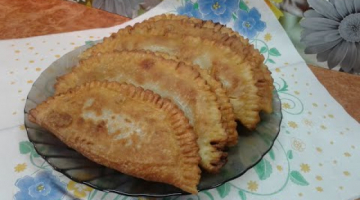
Chebureki are large, thin, half-moon fried turnovers-traditionally filled with raw minced meat and onions, then cooked quickly in hot oil until the crust becomes bubbly and crisp while the inside turns juicy and fragrant.
They’re not dumplings. They’re not empanadas. They’re not a hand pie in the American diner sense, either-although they live in the same family of “portable comfort.” A cheburek is all about contrast: thin dough, fierce heat, and filling that releases its juices at the exact moment you bite.
If you’ve never had one, imagine this: the crust crackles like a chip, but it’s still tender enough to chew. The meat tastes deeper than it should for something cooked in two minutes. The onion becomes sweetness and broth. And your kitchen smells like a street market you wish you could visit whenever you wanted.
Why Scalded Dough Makes the Crispiest Crust
The boiling water trick (and what it does)
When boiling water hits flour, two helpful things happen at once:
-
Starch gelatinizes: the starch in the flour swells and sets into a structure that holds moisture better.
-
Gluten tightens, then relaxes: the dough becomes elastic and less prone to tearing after it rests.
That means you can roll the dough extremely thin-without it ripping-so the crust fries into a brittle, blistered shell instead of a thick, bready blanket.
Why this dough rolls so easily
Hot water plus fat (butter here) coats some of the flour particles. Less sticking. Less fighting with the rolling pin. More control. You’ll feel it: the dough has a warm, obedient quality. You can stretch it thin enough to almost see light through it, and it still behaves.
The bubbles are not magic
Those signature “happy bubbles” on the surface happen because steam forms inside the dough layers while the outside sets quickly in hot oil. If your oil is too cool, steam can’t puff the crust before it absorbs fat. If your dough is too thick, it can’t blister properly. If you trap air inside the cheburek, it balloons aggressively and may burst.
So yes-bubbles are a sign of success, but they’re also a sign your timing and temperature are right.
Ingredients and Smart U.S. Substitutions
Below are your original ingredients, translated for a U.S. kitchen, plus the choices that make the biggest difference.
Dough
-
All-purpose flour: 3.5 to 4 cups (about 420–520 g depending on how you scoop)
Tip: if you can, weigh it. If you can’t, spoon flour into the cup and level it-don’t pack it. -
Fine salt: 1/2 teaspoon
(Your text says “1,2 part of a teaspoon,” which reads like about half a teaspoon in practice.) -
Boiling water: 1 cup (240 ml), freshly boiled
-
Unsalted butter, melted: 100 g (about 7 tablespoons)
-
1 large egg
Filling
-
Ground pork: 400–500 g (about 14–18 oz)
Best choice: pork shoulder or pork “butt” grind-not too lean. -
Onions: 4–5 medium onions, ground or very finely minced
-
Salt and black pepper: to taste
-
Ice-cold water or broth: 2–3 tablespoons (strongly recommended)
Oil for frying
-
Neutral oil with high smoke point: sunflower, canola, peanut, or vegetable oil
You need enough depth so the cheburek can float and fry evenly: ideally about 1 to 1.5 inches in a wide skillet, or deeper if using a Dutch oven.
Optional (but useful)
-
A little extra flour for dusting
-
A fork or crimper wheel for sealing
-
A thermometer (highly helpful; not “fancy,” just smart)
Step-by-Step: Making the Dough
There’s a rhythm to this dough. Flour breathes. Boiling water flashes. The spoon scrapes the bowl. And suddenly it feels like the kitchen got warmer in a good way.
1) Prep the flour
Put 3.5 cups flour into a large bowl. Add salt. Mix.
Make a well in the center, like a crater. This is not decoration-this is to help you stir quickly without flour exploding everywhere.
2) Scald (brew) the dough
Pour in 1 cup boiling water in a thin stream while stirring immediately with a wooden spoon.
It will look wrong at first. Clumpy. Shaggy. Like you ruined it. You didn’t.
Keep mixing until the flour is mostly hydrated and you have a hot, uneven mass.
3) Add butter and egg (without cooking the egg)
In a small bowl, beat 1 egg. Add melted butter that has cooled slightly-warm, not scorching. If your butter is so hot it hurts your finger, it’s too hot.
Pour the egg-butter mixture into the dough. Stir fast. The dough will become smoother and richer-looking.
4) Knead
When it’s cool enough to touch, transfer to the counter.
Knead 7–8 minutes. Add flour only as needed-usually a couple tablespoons, sometimes a little more depending on humidity and flour brand.
You’re looking for dough that is:
-
Smooth
-
Warm
-
Soft but not sticky
-
Elastic, like it wants to cooperate
5) Rest (non-negotiable)
Wrap the dough tightly (plastic wrap works best) and let it rest at room temp at least 30 minutes.
This rest is not laziness. It’s chemistry. Gluten relaxes. Rolling becomes easy. Sealing becomes reliable.
Make-ahead option
You can make the dough the night before. Refrigerate it, then bring it back to room temperature for about an hour before shaping.
Juicy Pork Filling That Doesn’t Dry Out
Chebureki live or die by the filling. Dry filling turns them into a chore. Juicy filling turns them into an event.
1) Meat: cold, not frozen
Use ground pork with some fat. Lean meat cooks fast and dries fast. A little fat is not “bad” here-it’s the reason the inside tastes rich and stays tender.
2) Onion: lots of it, and very fine
Four to five onions sounds aggressive. It is aggressive. And it’s correct.
Grinding onion through a meat grinder is classic because it distributes onion juice evenly. If you don’t have a grinder, mince very finely or grate on the large holes of a box grater. You want onion that melts into the meat, not big crunchy chunks.
Add onion (and all its juice) directly to the meat.
3) Season boldly but cleanly
For about 1 pound of meat, start with:
-
1 teaspoon salt (minimum)
-
Plenty of black pepper
Mix well.
4) Add icy water or broth
This is the small trick that makes a big difference. Add 2–3 tablespoons ice-cold water (or cold broth). Mix until the filling becomes glossy and slightly sticky.
That sticky texture means proteins are binding and will hold juices better during frying.
5) Keep the filling cold
If your kitchen is warm, refrigerate the filling while you roll the dough. Cold filling is easier to spread thinly and less likely to leak.
Shaping Perfect Half-Moons Without Tears
This is the part where most beginners lose confidence. Don’t. Chebureki are forgiving-if you follow the order.
1) Divide the dough
Cut into 16–18 pieces (about 40 g each if you like precision). Roll each into a ball. Lightly dust with flour.
Keep the unused dough covered so it doesn’t dry.
2) Roll thin
Roll each ball into a circle about 7–8 inches wide.
Thickness target: 1–1.5 mm. In American terms: very thin-thinner than you think you should.
If the dough springs back, give it a minute. It’s telling you it needs a little more rest.
3) Add filling on one half
Spread about 1.5 tablespoons filling on half the circle, leaving about 1/2 inch border around the edge.
Don’t mound it like a meatball. Spread it thin so it cooks fast and evenly.
4) Push out air
Fold the dough over into a half-moon and gently press from the center outward to remove air pockets.
Air is the enemy. Trapped air expands violently in hot oil and can pop the seam.
5) Seal like you mean it
Press the edges firmly with your fingers first.
Then crimp with a fork (classic) or use a crimping wheel. You can trim the edge slightly for a neat look, but don’t cut too close to the filling.
If you worry about sealing, lightly moisten the edge with water before pressing. Not too much-just a touch.
Set shaped chebureki on a lightly floured surface and keep them from touching too much.
Frying: Oil Temperature, Timing, Safety
This is where chebureki become chebureki.
Oil depth
Aim for about 1 to 1.5 inches of oil in a wide skillet. More is fine if you’re using a Dutch oven. Too shallow and the cheburek sits on the bottom and browns unevenly.
Temperature
Target 340–355°F (170–180°C).
This range is the sweet spot:
-
Hot enough to blister and crisp quickly
-
Not so hot that the crust turns hard before the meat cooks
If you don’t have a thermometer:
-
Dip the end of a wooden spoon into the oil. If bubbles gather around it immediately, you’re close.
-
Or fry a tiny scrap of dough: it should rise within 3 seconds and lightly brown within 30 seconds.
Frying process
Fry one or two at a time. Don’t crowd the pan.
-
Slide the cheburek into the oil carefully, away from you.
-
Fry about 40 seconds, then turn.
-
Fry another 50–60 seconds, or until both sides are evenly amber and blistered.
Remove to a rack or paper towels. A rack keeps them crisp longer.
Safety (real talk)
Hot oil splashes. Chebureki are big. Use long tongs or a spider strainer. Keep sleeves down. Don’t let kids stand near the stove during this step.
And never drop a cheburek from height-slide it in gently so the oil doesn’t jump.
Serving Ideas and Sauces
Chebureki are best eaten immediately. Not “soon.” Immediately. That crispness is a short-lived miracle.
Classic and simple
-
Strong black tea on the side
That old-school pairing works because the bitterness balances richness.
Cooling sauces (very American-friendly)
-
Garlic-dill yogurt sauce: plain yogurt, grated garlic, chopped dill, salt
-
Sour cream + herbs: sour cream, chives, parsley, pinch of salt
-
Lemony yogurt: yogurt, lemon zest, lemon juice, black pepper
Spicy and bold
-
A peppery tomato sauce
-
A chili-garlic sauce
-
Something tangy and sharp, not sweet
Crunch with crunch
A quick onion salad is perfect: thin-sliced red onion, a splash of vinegar, a pinch of sugar, salt, and let it sit 10 minutes. Bright, sharp, and it cuts through the fat.
Common Mistakes and Fast Fixes
The crust is soft, no bubbles
What happened: oil was too cool or dough was too thick.
Fix: heat oil to 350°F, roll thinner, fry in smaller batches.
The filling is dry
What happened: meat too lean, not enough onion, no added water/broth.
Fix: add another onion and 2 tablespoons cold water. Mix well until glossy.
Seams open during frying
What happened: trapped air or weak seal.
Fix: press out air before sealing; moisten edge lightly; crimp firmly; don’t overfill.
Oil foams or burns bits
What happened: too much loose flour or old oil.
Fix: shake off excess flour; strain oil between batches; top up with fresh oil if needed.
FAQ
Can I bake chebureki instead of frying?
You can bake them, but the result is a turnover-not a cheburek. Frying is what creates the blistered crust and that signature bite.
Why does my dough tear when I roll it?
Usually one of three reasons:
-
Not rested long enough
-
Too dry (too much flour added)
-
Rolled too aggressively without letting it relax
Fix: cover and rest the dough 20 more minutes. Roll gently. Use less bench flour.
Can I freeze chebureki?
Yes. Freeze them raw.
Place shaped chebureki on a tray, freeze until solid, then store in a freezer bag. Fry straight from frozen-just add about 30 seconds per side.
How do I keep them crispy for a party?
You can’t keep the “first bite” crisp forever, but you can manage.
Fry and place on a wire rack in a 200°F (95°C) oven for a short time while you finish batches. Don’t cover with foil or they’ll steam and soften.
Variations: Traditional, Modern, and a Little Wild
Once you master the base, chebureki become a playground.
Lamb + cilantro
A bold, classic direction. Add cumin and black pepper. Keep the onion heavy.
Beef + melty cheese
Use ground beef with decent fat. Add a bit of shredded mozzarella or a stretchy cheese. Expect extra steam-seal carefully.
Chicken + mushrooms
Cook mushrooms dry in a skillet first to remove water, cool them, then mix with ground chicken and onions.
Cheese + herbs (meatless)
Mix farmer cheese or ricotta-style curds with herbs, salt, pepper. For the dough, you can skip the egg if you want-just keep the scalding step and add a touch more fat.
Dessert chebureki
Make the dough without salt. Fill with sweetened farmer cheese, raisins, lemon zest. Fry quickly and dust with powdered sugar. Strange? A little. But it works.
Final Notes to Carry Into Tomorrow
Chebureki are not delicate food. They’re honest food-hot oil, simple ingredients, strong technique. And the technique is learnable.
Remember the pillars:
-
Scalded dough for elasticity and bubbles
-
Plenty of onion for sweetness and juice
-
Cold water/broth to keep filling glossy
-
Thin rolling, no trapped air
-
Oil at 340–355°F for crispness without greasiness
Make them once and you’ll understand why people chase that crunch. Make them twice and you’ll stop measuring your confidence in recipes by how complicated they look.
And yes-your kitchen will smell like someone just brought home a tray of golden half-moons, still sizzling, still loud, still impossible to ignore.